He was an older guy. She a younger girl. Very forward. Met him in a restaurant/sauna/workplace if some sort
We are in the future, rules are different. Women throw themselves at men perhaps
She almost get him to fuck her
I don’t remember how the other guy, younger, came into the picture. Maybe a war veteran
The big speech/song in which he describes her with loving words “and for all if this, you should marry the younger guy”
How he tricked her
How she wanted him to wear a tracking device because she thought of him as prey
How he left unseen, almost sliding down towards the lake, escaping beasts of pray to reach the house of San mamete.
How they met perhaps ten years later or more, she now an older widow, heavyset
It happens to all of us she said
It happens to all of us she said, around when we are 28-29 years old, we are given a chance to “grow up”, to jump to a higher level of commitment, intensity, dedication to our job or family or mission in life. Not every one takes it, the astrologist explained. Some of us decide to dodge this heavy burden and its promises, go one year backpacking instead. And for them, there simply isn’t a second opportunity, so timely and crucial to turn their life around at the right time. So this is a lesson, as with everything relating to Saturn (the astrologist was talking about the so called “Saturn return”), that require us to put our head down, do the work, accept the slowing down of it all.
So I was thinking about it, and how it somewhat it seemed to fit with the narrative of my life, thinking back to when I dropped out of that PhD course, probably the only person in Italy to ever do so on a fat scholarship, then dropped out of my career at the Faculty of Design entirely. It seems one of those things, though astrologically disconnected from the Saturn return which had happened three years earlier, that really gave a different, lowdown direction to a life that at that particular moment and following that pressure might have turned, in quite the standard way, very successful.
Yet when I speak about this, to myself, I tell it very differently.
I, for one, specify this: not that this is important in an absolute sense, that we respond to this call or we don’t; not that it matters, unless we think back about it in a way that gives it importance; it doesn’t matter! because it is not of us to know if really what is asked of us is what is best of us. What the “Saturn return” does, is describing this particular, unique opportunity and transition in our lives. This doesn’t mean that, having missed the opportunity, one’s life is “ruined” or irreparably damaged. Yes maybe, if we had responded to this call in the right way, at the right moment, we would find ourselves later on living in that beautiful place we had dreamt about: with all those beautiful things we wanted. But does this mean being happier, more satisfied, twenty years down the road? more able to understand ourselves or the others? capable to give and receive love? Generous, brave, faithful, moral? Of course not, since it is proved that our level of satisfaction or happiness, even our moral code, in the long run, does not depend on where we live or how much money we have, but from our relationships, and how open we are to them…
I would argue then that the “Saturn return” is a crucial moment in which we are given the opportunity to be more productive and useful members of society. But then again, this assuming we appreciate and want to collaborate with society. But this is for another time.
L’annunciazione di Melozzo

Melozzo.L’annunciazione di Melozzo, al Pantheon.
Non oscurabile dal tetro legno delle Tombe dei Re, scortata dai simulacri esausti delle antiche divinità, anch’essa creazione di una divinità dimenticata. Uno dei quadri più religiosi che abbia mai visto, qui così ben incastonato sotto il piccolo cielo di Adriano.
Fuori, gli inavvicinabili tavolini del bar dove Parise ha abbordato Giosetta Fioroni in un altro giorno di pieno sole in un’altra Italia che fu completamente immaginaria.
“Ma in quel posto dove c’erano quei due che si picchiavano con l’ombrello mi hai fatto fretta”.
Mussolini.“Ma in quel posto dove c’erano quei due che si picchiavano con l’ombrello mi hai fatto fretta”. Bambina spazientita dice alla nonna, nella sala d’attesa del dentista.
Poco dopo: “Non vedo l’ora quando compriamo la tartarughina”.
La musica suona “the sound of silence”. La bambina sbuffa. La nonna la calma con la voce dolce e bassa che gratta alle curve e non si decifra dall’altro lato della stanza.
“La tua camera è un po’ in disordine” ha detto la nonna.
“Eh! ma io ci campo dentro!”
Questa bambina con questa nonna dolce al suo servizio mi ricorda un po’ Mussolini. Forse per gli occhi tondi, per la forma della testa o per il vociare e lo sbuffare così sicuro di sé.
Così immagino Mussolini bambino sbuffare in una sala d’attesa di un dottore, circa 1890, con una nonna apprensiva a fianco.
“Poi ci compriamo il gelato”
“Che noia che noia che noia”
“e la tartaruga”
“che noia mortale nonna!”
Dove finiamo, bambini lamentosi, simpatici e innocui che fummo? Finiamo negli eserciti, nel traffico, negli uffici, nelle vacanze, nei vestiti alla moda, nei cinema. Finiamo, e di noi restano forse l’impazienza, la delusione incompresa, la crudeltà inconscia.
La bambina: “Milano non mi piace, è brutta”.
“Come! Non ti diverti qui?”
“Io mi diverto se qualcuno mi da’ retta.”
“Ma non c’entra la città con questo.”
“Invece sì.”
“Che noia io non ci voglio invecchiare qui! Poi divento una nonnina!”
“E’ bello essere una nonnina.”
“Sì così poi invecchio e muoio e non devo più stare qui ad aspettare.”
A queste parole la nonna si è passata la mano sul viso, coprendosi per un istante gli occhi. La bambina invece non si è accorta di niente, occupata com’è a fare gli occhi storti a mio beneficio.
I’ve lived a few many years at this point even discounting those lost in the clutches of TV or the Internet
Foodies of Portlandia.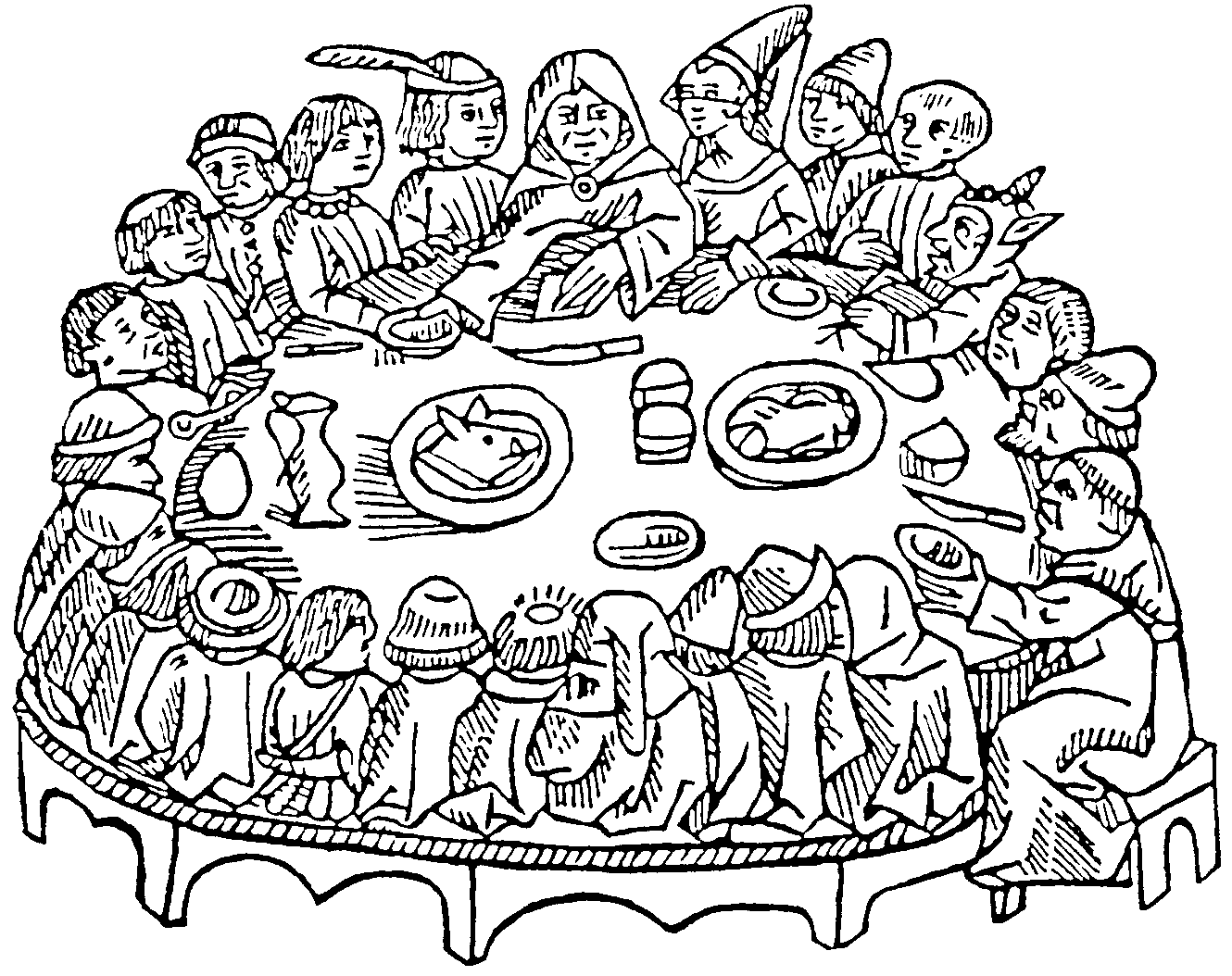
at the table.I’ve lived a few many years at this point even discounting those lost in the clutches of TV or the Internet… yet it is only recently that I’ve learnt to stop engaging in disputes over the quality of the nutrients in the grub I ingest. Despite my origins and the collective obsession of my people with this topic, I don’t discuss olive oil anymore or the best way to bake bread or why soy isn’t good for you or what eggs I dream to eat. It is one of those things that should fade with age, like overstated interest in sports or Stanley Kubrick. Nowadays I listen to the words and chew the food in silence as these conversations have lost all meaning to me. They are fodder, burden to the mind, divisive or foolishly unifying, they vacuum the mind of ideas and intentions… It does make me sad a bit if I think of the many who are still there, a few feet from me, trapped in such debates over whether one meal is healthier than another. These conversation destroy you… they bring your stomach up to your brain and at the center of your emotions, leaving much less space to think about, for example, people who do not eat as much as us, because they can’t. In fact these conversations are meant to prop you up and give a meaning to the daily grind of providing the food and preparing it, certainly they’re not set for spoiling it or reveling in their own meaninglessness. In truth these exchanges have always existed, have always been stupid and have always oppressed the soul while the body sat at the table. It is just that now, they are all that is left. It was disgusting, but the never ending discussions over politics of fifty years ago provided some variety… and those about poetry and cinema and art as well. Now… People don’t talk about anything else. Food alone is left to sustain us in the appalling task of chewing and digesting and living a life of meaning — but leaving the soul impoverished, vanquished by the material preoccupations, the futility of the disagreements over alimentary choices. They are desperate efforts to hover above the crude or poetic parts of life, which our souls don’t know how to handle or better, which would wake up our dormant souls and then who knows what might happen.
The news came from above the refrigerator and the little boy sat at the red table drawing
Mao is dead.a washing machine.The news came from above the refrigerator and the little boy sat at the red table drawing, occasionally talking to his mother who was preparing lunch. He wanted to draw a garden and looked out but it did no good. Outside, the backyard was slowly turning into a wasteland. Whatever was metal was getting rusty and scabs of dark green paint came off the railings and the fence. The scabs were white on the inside. The bushes and trees were dying and there was an old drying rack abandoned on the terrace, also rusty where the plastic coating had come off. The pieces of broken glass cemented by his father on top of the wall before he was born glimmered in the daylight. The little boy knew that every cat walked in between the splints of beer bottles without any problem, a thought that never failed to make him happy. But he could not draw it. The ruins of the garden were sad and unjust.
It was an unhappy house with colors. The tiles in the kitchen were large and yellow. The floor in the corridor green. The door to the bathroom was blue. The studio had an orange couch, and a dark wooden floor. On the W.C. it was stamped “Ideal Standard” in blue. The double window frames were white-cream in the inside and green on the outside and the walls were white and there were pictures hanging everywhere. A drawing of his was on the fridge door. In one room the walls were violet and blue. It used to be his father’s studio. It also used to contain a scaffolding which his father had painted dark brown and that had since been removed.
He remembered his father on top of a ladder burning shapes in the paper globe hanging from the ceiling, with his Galuoise cigarette.
The little boy wanted to think at the house more, at the times and things that it contained or had contained, but there wasn’t much. No memory no imagination no pleasure in remembering things. He never had friends over, the house was too strange and it contained his mother unpresentable most times and it had all these parts that were falling apart and nobody fixed. It was often broken into, gipsy boys and girls would enter and take something and piss and shit on piles of clothes and books and leave without taking anything, not even the TV. He wondered if the house was dying like the garden. He had never thought of that.
He recalled the arrival of Vodka in a box, how she had looked at him as he stood on the door to the living room, but sideways because she was scared. The turtles who dug themselves in the garden during winter, how Vodka would turn them over to chew on their bellies. The time he fell from the upper bunk bed and continued to sleep. Some of the faces of his mother’s lovers across the years, the dark mustache of the one who had given him the conductor’s hat.
Then the little boy remembered how in that same room one day when keeping company to his mother reluctant to cook, just like today and not so many years before, he had seen her crying. The TV news were on as well just like today and all the rest was almost identical except that the backyard was less of a wasteland and Nebbia was sitting at his place on top of the washing machine, looking upon the scene. His mother was standing in front of the black and white pictures, her face in her hand and sobbing. The newsman had just reported something serious.
“Why are you crying?” he had asked surprised.
“Because Mao is dead,” she had said.
The little boy laughed at the memory. His mother put down the glass of Campari: “Why are you laughing now?” she asked, ready to be amused. “I just remembered that time when you cried because Mao was dead”, he said with sympathy, but his mother with a half-smile, imperiously, denied it.
“How can you not remember!” the little boy insisted, “I remember it very well!”
“Well, it is certainly not true” she said in a final tone.
It was a pity that this memory, so clear in his head, could not be shared. This happened often to him and spoiled the pleasure of remembering.
Sometimes he would come back from school in the afternoon and find the apartment dark and quiet because she was sleeping; she might have been asleep since the night before, or just gone to sleep after lunch. One time, passing quietly her darkened bedroom he found the door to the kitchen closed. She had left the washing machine running and had gone to bed. The machine made a lot of noise, so she had left the doors closed. The machine was noisy in a rhythmical way so that its noise sometimes, when he heard it at night trying to fall asleep, could be transformed into short, insisting sentences which entered his dreams.
He sat eating alone in the kitchen trying to watch a TV he couldn’t quite well hear in all the racket and had a peculiar thought. He thought that, if the door of the kitchen had been left open, then there wouldn’t have been so much noise inside, because the noise would leave the kitchen going out through the door.
So he opened the door really wide (it was a double door) and sat back at the table, watching TV, trying to feel the noise diminishing as it left the room. He told himself he was justified in doing so, since he was only seeking a more quiet moment watching TV. He knew and didn’t know why his heart was beating so fast. It took a while, perhaps 10 minutes, during which the roaring of the machine had, if anything, increased its power and sense of urgency.
Finally, predictably, his mother stormed to the kitchen bellowing with a deep, scary, angry voice.
“KEEP THE GODDAM DOOR CLOSED! ARE YOU AN IDIOT!”
She slammed the two doors shut and stomped back to her room, cursing, slamming her own door as well. All the doors in the house had long glass plates in them which made especially dramatic, loud and risky their frequent slamming. Standing next to the table, one hand resting on the formica, his knees trembling slightly, he hadn’t dared looking up at her, just enough to catch a glimpse of her mass of dark hair, the half naked body, the screaming face in a blur.
He sat back into the din only for a short while longer until he decided to turn off the TV and leave through the garden, feeling scared and guilty and ashamed for his stupid thought about the noise leaving the room (how could he have thought of something like that?), though also with unquestionable pride for having been able to lure his mother out of her darkened bedroom.
At moments, it was real
Satie, 1ere GnossienneAt moments, it was real. She would say something and make him think she was “the one”. It was her grace or the gracefulness of her thoughts. How hard was she trying to make an impression? He hoped not at all.
But her eyes more than anything, looking back at him.
Most of the times, as it normally happens in life, the thing was not real, they were not really together, they were not seriously having dinner or talking about love and were not in the present.
Like music in the background which is not being listened to, while we discuss what to do tomorrow, when do we pay the bills, why a colleague used certain words, their presence each in the life of the other was overlooked or taken for granted when in fact the knowledge that the next day he would still have been there, and she would still have been there was the most important and worthy part of their everyday life. End of the fragment.
Dalla finestra vedo le betulle mosse dal vento nel parco giochi sotto la pioggia
le cime innevate.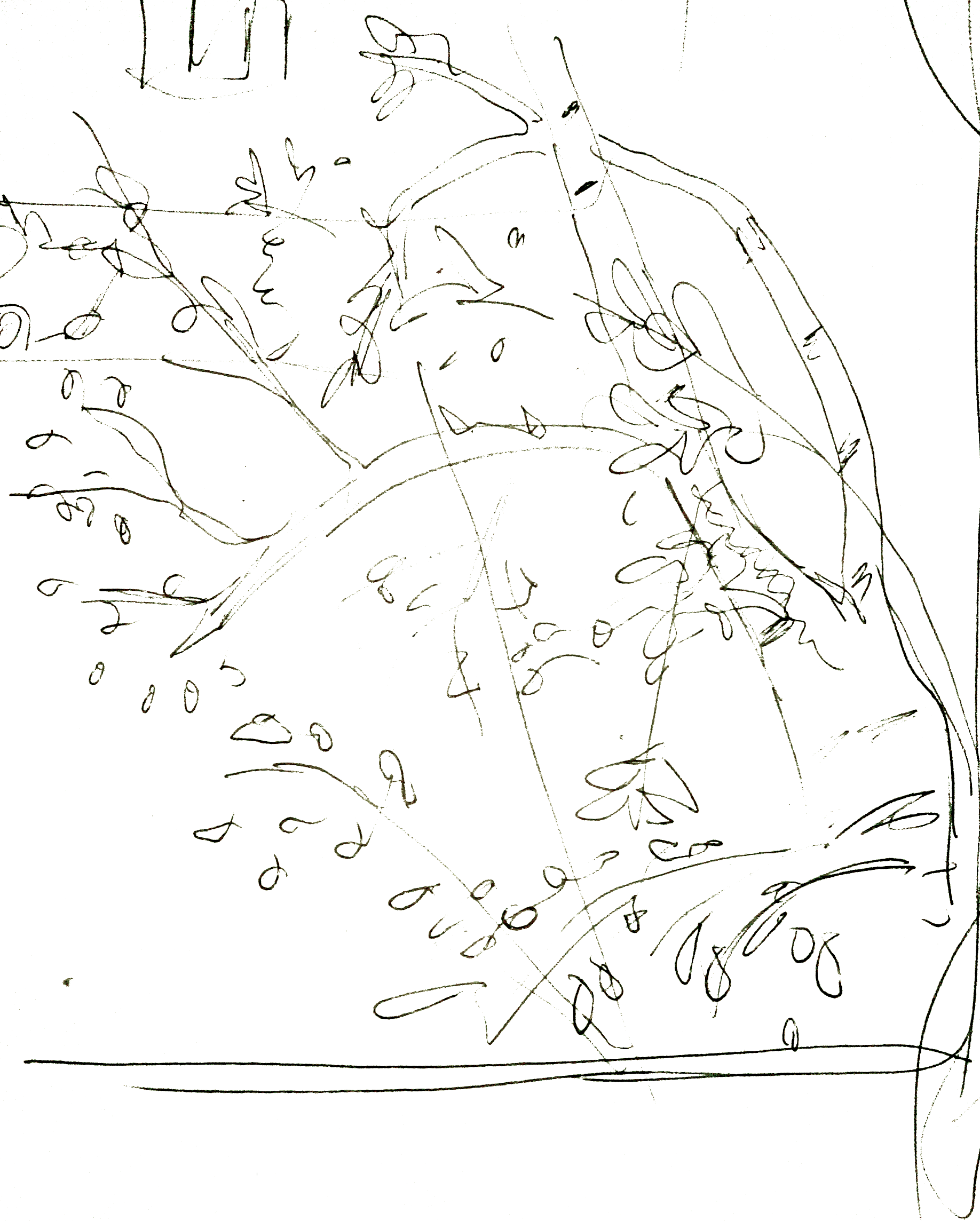
le betulle.Villa-Lobos, Aria. Canta Anna Moffo.

Dalla finestra vedo le betulle mosse dal vento nel parco giochi bagnato di pioggia. Due bambini corrono attraverso la spianata di sabbia e una signora stretta in una felpa verde smeraldo si avvia verso l’emporio seguita poco dopo da un’altra donna più giovane, con una lunga gonna blu scuro e uno scialle rosa che le copre la testa. Sopra il quadrilatero condominiale c’è un tetto di nuvole che si muove pianissimo o per niente.
Il camion dell’uomo delle bombole non arriva e Selina è stufa, l’impasto del pane è pronto ed è ora di accendere il forno e poi tutt’a un tratto ha voglia di tè, prima non ci aveva pensato ma siccome il gas è stato promesso un’ora prima non è giusto adesso che si debba aspettare, quando una persona ha proprio bisogno di bere un bel tè caldo, sedersi nella propria cucina al calore del forno, senza accendere la luce, rispondendo ai messaggi.
Dalla finestra del bagno, sull’altro lato della casa, si vedono le lunghe tubature gialle del metano piantate a mezz’aria lungo il parcheggio. In fondo a destra fra due alberi c’è un pezzo della strada.
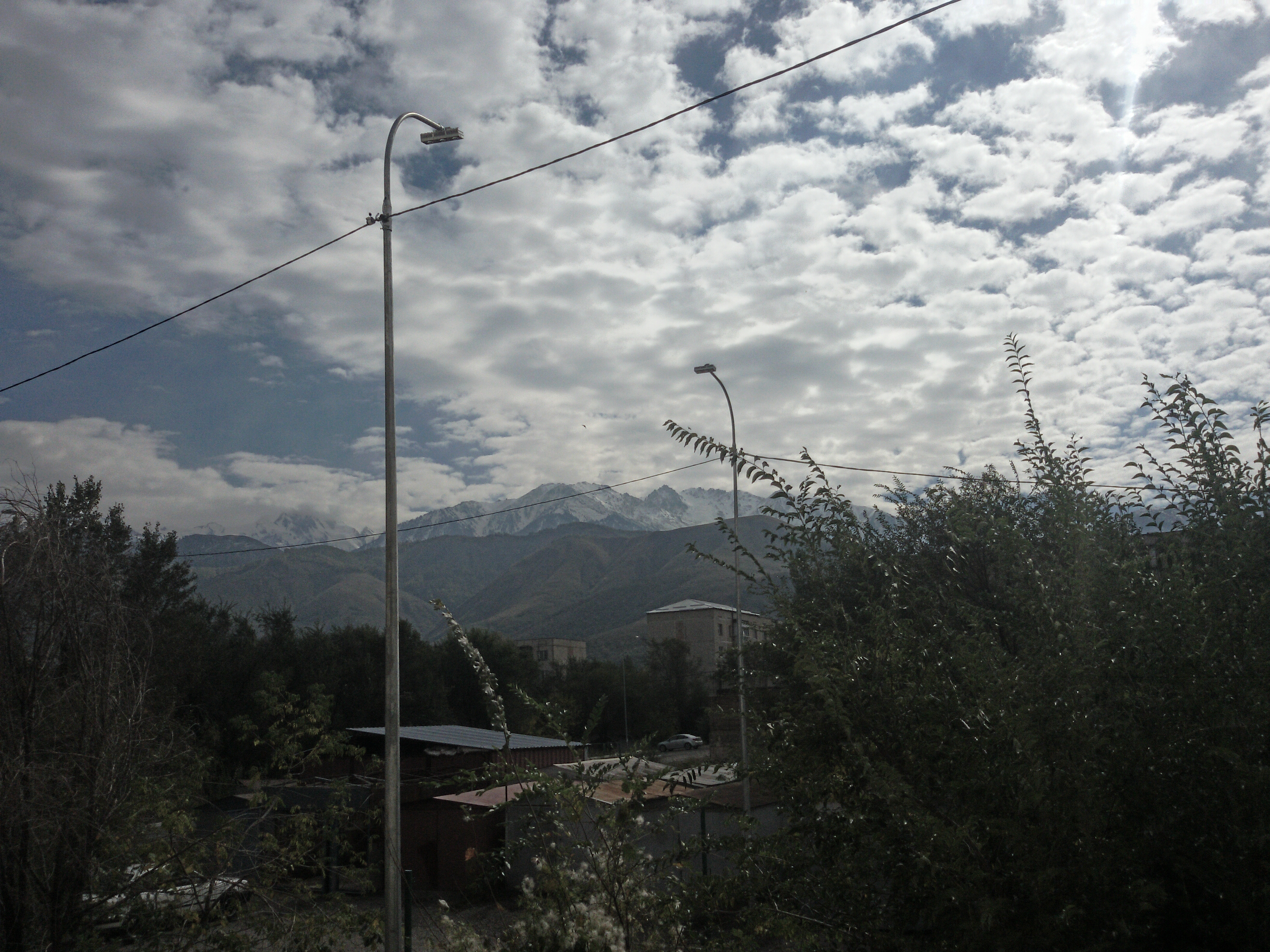
La strada porta qui dal fondo della valle seguendo un fiume dall’acqua molto bella e finisce non molto più in alto, dopo la diga di contenimento, in un vasto parco naturale. Quando le nuvole non sono sedute sulle vette, da tutto intorno si possono vedere le cime innevate del Pik Talgar, bellissime e sublimi al tramonto, dietro altre montagne dal profilo più dolce, verdi e nude o coperte di alte conifere.
Questa descrizione di cose naturali è veritiera eppure falsa e non fa fede per nulla all’esperienza di vivere qui oggi, nell’insediamento pionieristico sovietico Miliorator dove Selina è cresciuta senza gas metano e con le bombole e il riscaldamento a diesel ma nel mezzo di un bel parco e in riva ad un fiume incontaminato. Ora tutto è assediato dallo sviluppo selvaggio dei castelli kazaki, grandi case senza giardino costruite come isole su spiazzi d’asfalto, circondate da alti muri nudi di blocchi di cemento con cancellate cieche di metallo nero, e poi da tutto un rivolo di immondizia distribuito lungo le vie e nelle macchie, cicche tappi polistiroli, imbottiture di sedili, tappeti di preghiera sdruciti, bottiglie fazzoletti batterie lattine, scarpe spaiate sperdute su strade fangose e irregolari, sterpaglie che si nutrono dei vecchi sentieri, auto parcheggiate in disordine lungo i campi inutilizzati, sporadiche mucche al pascolo o asini battuti a morte, edifici mezzi costruiti o evacuati, cani randagi che inseguono le macchine sbucando da altre strade più tortuose dimenticate fra i parchi abbandonati e i ciuffi di erba, dove mattoni e pezzi di amianto come gettati fra i cespugli vanno in polvere negli anni.
Niente sembra stare insieme. A guardar bene tutto ha quell’aspetto triste di qualcosa che era sì abbastanza bello ma che si è trascurato troppo a lungo, forse irrimediabilmente, e che ora, nonostante lo sviluppo alacre tutt’in giro, per le tante decisioni sbagliate che lo imbruttiscono in fondo dovrebbe solo essere lasciato perdere, in favore di altri luoghi chissà dove.
Molti qui usano stufe a carbone che alimentano gruppi di appartamenti lungo certe trombe di scale. Quando il camion del carbone viene, se non piove, rovescia sulla strada una montagna di carbone, il più possibile vicino alla scala. Per raccogliere tutto il carbone riempiendo due secchi alla volta, facendo numerosi viaggi, ci possono volere anche due ore. I bambini giocano coi pezzi rimasti. Tirandoli con forza sull’asfalto fanno come delle esplosioni nere.
Selina ha deciso di chiamare di nuovo la compagnia del gas. Molto gentilmente spiega le sue ragioni parlando con calma nell’apparecchio, appoggiata al lavabo, il bel capo biondo che quasi sfiora lo specchio. E’ la seconda volta che chiama, spiega, perché l’uomo delle bombole proprio non s’è visto. Quando ringrazia e chiude la telefonata si sente un po delusa come di chi sa di non essere stata capita davvero, che l’impasto del pane, il tè, e la cucina un po’ umida nell’ombra con la lunga panca angolare intorno al tavolo basso e i messaggi che aspettano e il bambino che dorme e il marito che brontola (io) e il vento fra le foglie di betulla bagnate di pioggia non sono stati inclusi nella conversazione con la signorina della compagnia del gas.
Ora il quadrato del campo giochi è animato dall’arrivo della babysitter. E’ una donna robusta, sui sessanta, con i capelli nello scialle e un cappottone largo. Il largo viso asiatico è improntato ad una maschera paziente e tollerante, ma anche stanca come di fare finta. La seguono quattro bambini piccoli, di diverse età, che ripetono in lingua kazaka dopo di lei i numeri da uno a dieci. La seguo con gli occhi e così vedo che il camion è arrivato davvero e che, scaricata la bombola color ruggine, un uomo ha salito le scale al nostro portone e ora sta suonando il campanello. L’uomo è alto, veste un completo militare e porta i baffi spioventi che sono dello stesso colore dei capelli rosso bruni come il colore della bombola nelle parti arrugginite, quando entra ha la schiena non troppo storta dal portare bombole, un sorriso amichevole e spiccio su di un viso semplice e forse buono che fa subito simpatia a Selina.
Subito con la sua facilità istintiva e curiosa ha iniziato una conversazione che non ha niente a che vedere con la bombola del gas e l’impasto del pane. Un momento dopo l’uomo parla di suo figlio, che vive a Novosibirsk dove lo sta aiutando a costruirsi la casa. Parla di quanto costa la vita in Russia e di come si vive laggiù, di come le cose funzionano e non funzionano. Mentre Selina accende il forno, e ha già messo il bollitore sul fuoco, l’uomo accenna al lavoro del figlio (fa insegne luminose) e alla moglie, che non lavora.
Più tardi Selina può finalmente infornare il pane, prepararsi il tè e leggere con calma tutti i messaggi seduta alla lunga panca, nella cucina ombrosa. Fuori non si vede più nessuno, lo scivolo di metallo e le altalene luccicano appena e il vento muove sempre le foglie di betulla bagnate di pioggia.
Tomorrow 10 of March
now.
2009.I pedal lazily on the roads that take away from Cadilù and go all around in Lombardia and they come back. I pedal by a field where a tractor lifts one of the two last bales of hay, moving it for a few yards towards the other one that lies on its side and looks like a big reel of thread. With a very elegant move, pushing one bale against the other, the tractor knocks over the laying bale and puts the other one on top of it. As the scene disappears at my side, the tractor is just carrying away the two bales towards the barn. The field, freshly cut and smooth, is all empty now.
There are no wild flowers in August.
You don’t need me to write you that I miss you. You were another lover who lives another life, mysteries I will never solve. I am still what you knew, ashamed and proud of it (after all it was always that way). Today, a slice of my time into the late sun, I felt that shame was smokes and mirrors.
From a window, somewhere unfathomable beyond it, came the waves of a song to which I would not add or from which take a thing. I sung it all the way home.
~*~
This was how my last “blog” ended, back in 2009. Pedaling through the Lombardy plains, thinking about a girl of whom today I barely remember the character, or anything that made her a lovable or hateful person. I am now several thousands miles away, outside there’s drizzle, calls of sinichkas (here too) and the distant rumble of the disorganized young city I live in. Tomorrow things will happen; tonight perhaps I’ll have troubles falling asleep and I’ll read Ask the dust until late.